University of Dayton International Merit Scholarship 2026/27: What It's Really Worth
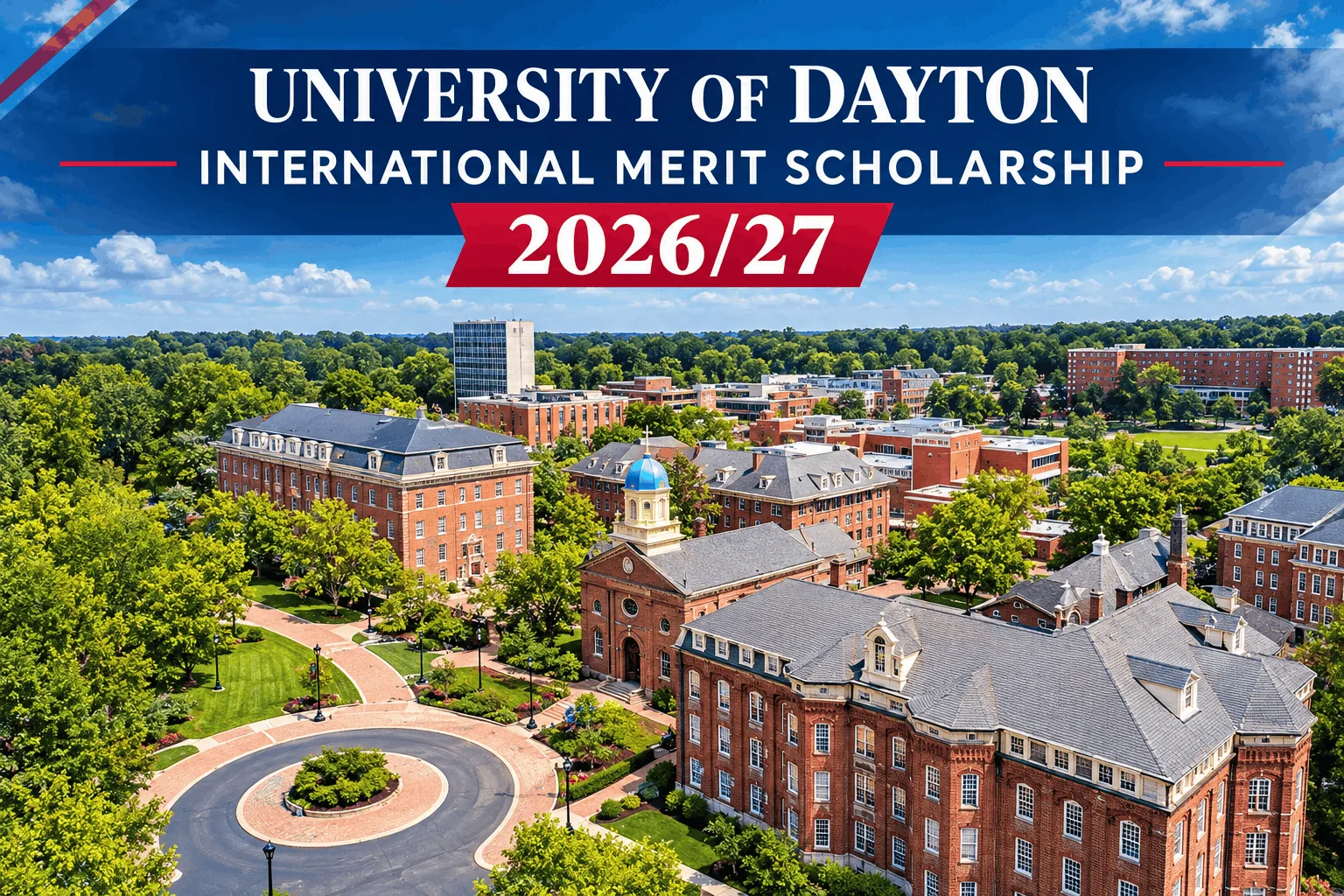
- Country
- USA
- Level
- Undergraduate
- Funding
- Partial funding
If you have seen the University of Dayton advertised as a "fully funded" scholarship, this guide will be more useful than those pages, because it tells you the part they skip: what an international student actually receives. The University of Dayton, a respected Catholic research university in Ohio, does offer generous merit scholarships to international undergraduates, and they are automatic and substantial. But they are partial tuition awards, not full rides, and understanding the real numbers is what lets you plan your finances and visa properly. This is the honest, detailed version.
The honest headline: a large tuition cut, not a free degree
The University of Dayton's international merit scholarships reduce tuition, often substantially, for strong undergraduate applicants, and are awarded automatically when you apply. Officially, they are worth up to $34,000 per year toward tuition, and the university states clearly that it does not offer full-tuition scholarships. That is genuinely valuable: the majority of international undergraduates receive one of these awards on admission, and for a strong student the tuition reduction can reach that $34,000 ceiling. But it is a reduction, not a removal, and it does not touch housing, meals, or living costs. So the right mental model is "a big discount on tuition," not "a free US degree." Read it that way and you will plan correctly; read the "fully funded" headline literally and you will be caught out.
What the award covers, and what it does not
- Covered: a significant portion of tuition, scaled to your academic record, plus often a textbook or book-cost award.
- Not covered: housing, meals, health insurance, and general living costs, plus the remaining portion of tuition after the award.
US private universities have a high total cost of attendance once you add housing, food, insurance, and living to tuition. A merit award brings tuition down meaningfully, but a substantial annual balance remains, and that balance is your responsibility, especially since international students cannot access US federal financial aid.
A full worked budget
Here is the honest shape of the real cost for an international undergraduate at Dayton, after a strong merit award:
- Remaining tuition: a meaningful share of tuition after the merit reduction.
- Housing and meals: a major annual cost, whether on-campus or nearby.
- Health insurance: required for international students and a real annual expense.
- Living costs: Ohio and the Dayton area are more affordable than coastal US cities, which helps, but day-to-day costs still add up.
- Visa proof of funds: you must show you can cover the full remaining cost for your student visa.
The honest conclusion: a Dayton merit award makes a US degree more achievable, and the Midwest location keeps living costs lower than in big coastal cities, but you should budget for the remaining tuition plus all living costs across four years before committing. Work out the full four-year figure with your award applied, and confirm you can fund the gap.
Who is eligible
- International undergraduate students with strong academic records.
- Applicants who apply for admission (consideration is automatic; no separate form).
- Applicants who submit any required documents and test scores on time.
Because the award is automatic and based on your record, the single best thing you can do is present the strongest possible admission application, since that determines the size of your scholarship.
How to apply (there is no separate form)
- Apply for admission to the University of Dayton as an international undergraduate.
- Submit your academic records and any required test scores, since these determine your merit award.
- Meet the term deadline (commonly around 1 May for fall, 1 November for spring).
- Review your offer, which states your specific merit award and any textbook award.
- Plan your full budget around the remaining tuition plus living costs, and prepare visa proof of funds.
A realistic timeline
- Up to a year before entry: build your academic record and prepare any required tests.
- Several months before the term deadline: complete your admission application early for the best consideration.
- On receiving your offer: compare your award against the full cost of attendance.
- Before committing: confirm you can cover the balance, including housing and insurance.
- After acceptance: complete visa steps, including proof of funds for the remaining cost.
Why Dayton can still be a smart choice
A partial award is not a weak option when the overall cost is manageable. The University of Dayton is well regarded, particularly in engineering, business, and the sciences, with a strong, welcoming international community and a genuine focus on student support. Its Ohio location means lower living costs than universities in New York, Boston, or California, so a large merit award plus affordable Midwest living can make a US degree realistic for a well-prepared student. The point is simply to decide based on the full, honest cost rather than the headline.
Common mistakes to avoid
- Believing the "fully funded" label. These are partial tuition awards, not full rides.
- Forgetting living costs. Housing, meals, and insurance are not covered and add up.
- Assuming US federal aid. International students are not eligible, so plan private funds.
- Applying late. Consideration is automatic, but earlier applications fare better for scholarships.
- Budgeting on the award alone. Plan for the remaining tuition plus all living costs over four years.
How to strengthen your merit award
Because the scholarship is automatic and scaled to your academic record, the size of your award is largely decided before you even apply, by how strong your record is. To get the most:
- Maximise your academic profile. Strong grades and a demanding course load directly affect your award tier.
- Submit required test scores where they help, since they can factor into merit consideration.
- Apply early in the cycle, as earlier applicants generally fare better for scholarship funds.
- Present a complete, polished application, so nothing weak drags down an otherwise strong record.
- Ask admissions about your specific award, so you know your exact figure before deciding.
There is no separate essay to win more money; the lever is simply being as strong an admit as possible and applying on time, which is within your control.
A sensible US application strategy
A single partial award should never be your whole plan for the US, where costs are high. Apply to a range of universities: a few with strong need-based aid for internationals (which can beat any merit award if you qualify, though they are very selective), several like Dayton with attainable, generous merit awards, and some in lower-cost regions where the total bill is simply smaller. This portfolio approach means that whatever happens, you end up with at least one genuinely affordable, funded path, rather than pinning everything on one scholarship that may still leave an unmanageable gap. For many international students, a strong merit award at an affordable-region university like Dayton, combined with family support, is exactly the kind of realistic, fundable plan this strategy is meant to produce.
How it compares to other US options
Because US costs are high and merit aid rarely covers everything for internationals, apply to a range of universities rather than counting on one. A small number of wealthy US universities offer strong need-based aid to international students and can be cheaper than any merit award if you qualify, though they are extremely selective. Other universities in lower-cost regions, including many public universities, can produce a lower total bill. Treat Dayton's generous merit award as one good, attainable option among several, so you end up with at least one genuinely affordable, funded path to study in the US.
After the University of Dayton
A University of Dayton degree is well regarded, and the university's strengths in engineering and business, plus its location in a region with real industry, support internships and graduate outcomes. US post-study work options such as Optional Practical Training (OPT) let eligible international graduates gain experience after their degree, subject to current rules, with an extension for eligible STEM fields. For a student who can fund the balance, a Dayton merit award offers a solid, supported route to a US education and career start, and the university's affordable-region location means both your study years and any early career steps in the area come without big-city living costs, which stretches the value of the award further than it would go in a coastal metropolis.
Apply and confirm the details
Check the current merit scholarship amounts, eligibility, and term deadlines, and apply, on the official University of Dayton international admissions pages: University of Dayton international admissions, official site.
Explore more opportunities: browse all our scholarships, prepare for admission with our free IELTS and English prep, or learn how we verify every opportunity.
Disclaimer: OurScholarships is an independent information platform and is not affiliated with or endorsed by the University of Dayton. Amounts and deadlines change each year, so always confirm on the official source before applying.
Frequently asked questions
Is the University of Dayton scholarship fully funded?
No. The University of Dayton international merit scholarships are partial tuition awards, not full rides. Officially they are worth up to $34,000 per year toward tuition, awarded automatically when you apply, and Dayton states plainly that it does not offer full-tuition scholarships. They do not cover housing, meals, or living costs. So they make Dayton more affordable rather than free, and you should budget for the significant remaining cost.
How much is the merit scholarship worth?
It varies by your academic profile, but the international merit awards commonly provide a large annual tuition reduction for strong undergraduate applicants, awarded automatically when you apply. There is also typically a textbook or educational-materials award (for example up to several thousand dollars). The exact amount depends on your record, so treat the headline figures as a range and confirm your specific award in your admission offer.
Do I need a separate application?
No. International undergraduates are generally considered automatically for the merit scholarship when they apply for admission; there is no separate scholarship form. Your academic record does the work, so a strong application is what secures the larger awards. You should still submit any required documents and test scores on time.
What are the deadlines?
The University of Dayton uses term-based deadlines, commonly around 1 May for a fall (autumn) start and around 1 November for a spring start, though dates shift by cycle. Because exact dates change, confirm the current admission deadlines on the official University of Dayton international admissions pages, and apply early for the best scholarship consideration.
How much will I still need to pay as an international student?
A significant amount. Even with a strong merit award reducing tuition, you still pay the remaining tuition plus housing, meals, health insurance, and living costs, which together add up substantially at a US private university. International students are not eligible for US federal aid, so plan to cover the balance through family funds, savings, or other scholarships, and budget for your student visa's proof-of-funds requirement.
Is the University of Dayton a good choice despite partial funding?
It can be, for students who can fund the balance. Dayton is a well-regarded Catholic research university in Ohio with strong engineering, business, and sciences, a supportive international community, and a lower overall cost than universities in the most expensive US cities. A large merit award plus manageable Midwest living costs can make it realistic, provided you plan the remaining cost honestly.